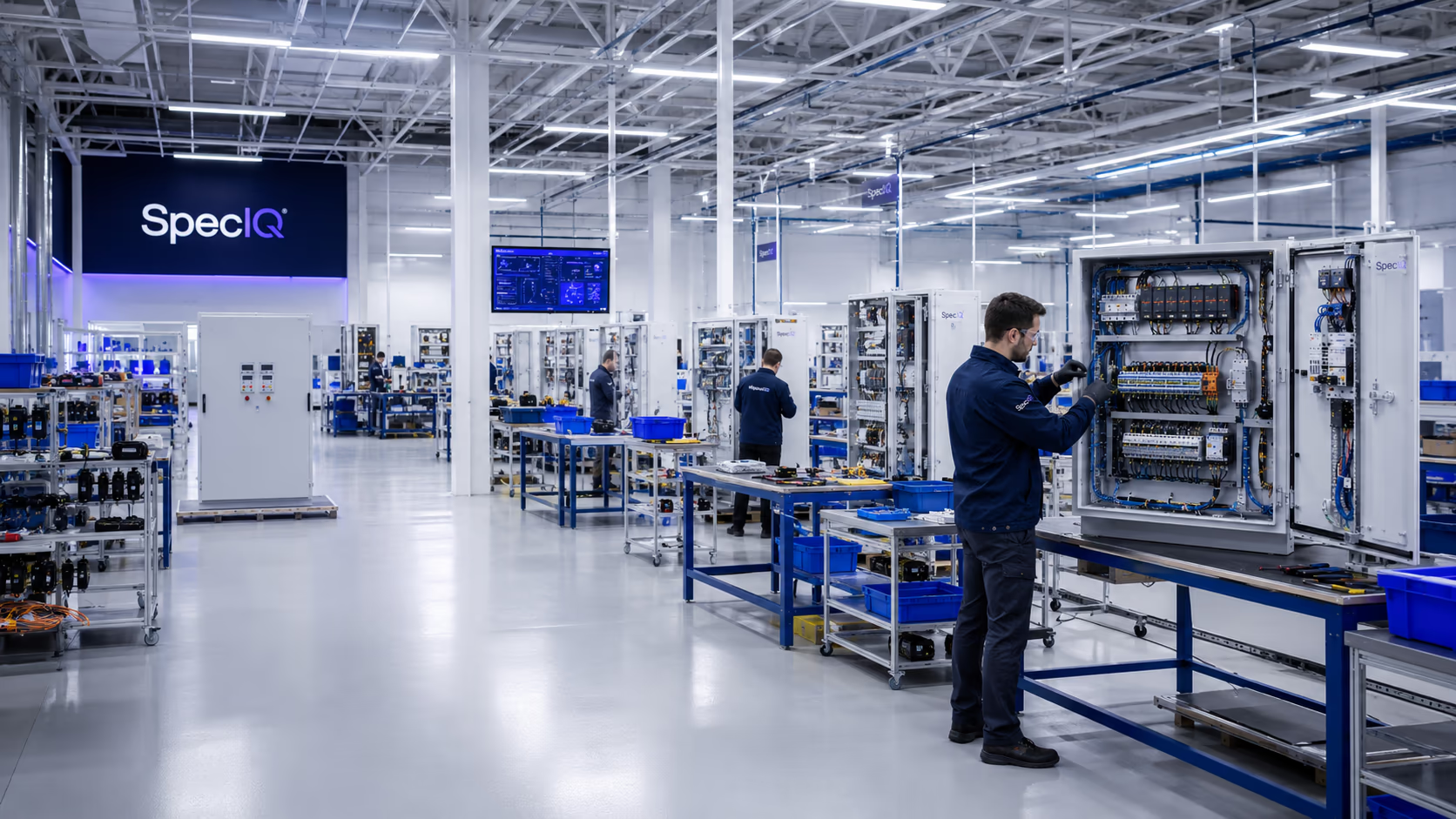
Walk into almost any commercial construction site this week and you will find someone building a control panel on a bucket in a mechanical room. Same components from the same distributor. Different technician than the one who built the panel one floor down. Wiring colors and terminal-block layouts that vary subtly from panel to panel, depending on which tech landed on which lift that morning.
This is the normal way North American building-automation panels get made. It has been the normal way for forty years. It stopped making economic sense about the time iPhones became standard issue.
How field-building became the default
The honest answer is that field-building made sense in the early days of building automation, when controls were expensive, custom, and small in volume. A typical site had two or three control panels. Each one was genuinely unique to that site. Shipping a panel from a factory across the country didn’t pencil out — the freight cost was a meaningful percentage of the panel cost, and the variations from site to site meant the factory couldn’t pre-build anything ahead of demand.
That early-days math has shifted in three ways:
- Panel counts per site have multiplied. A modern Class A office building deploys dozens of controllers across the HVAC, lighting, security, and metering systems. A hospital deploys hundreds.
- The variations between sites have collapsed. A standard BAS panel for a rooftop air handler in Cleveland is functionally identical to the panel for the same equipment in Phoenix. Brand and model of the controller might vary, but the panel design itself is standardized.
- Factory production costs have dropped. A panel that took a skilled builder four hours in 2005 takes 90 minutes in a properly tooled factory in 2026, with better consistency and full documentation.
The economic case for field-building is gone. The habit isn’t.
The hidden cost ladder
The cost case against field-building has four rungs. None of them show up on the original project budget; all of them eventually get billed.
Rung 1 — labor stratification
A field-built panel is built by whichever tech is on-site. Some are excellent. Some are first-year apprentices. The variance is dramatic, and the variance compounds — a panel built by a senior tech still has to be serviced later by whoever’s on call, and the next service tech may not know why the senior built it the way they did. Factory-built panels are wired by builders who do nothing else, eight hours a day. The labor quality is uniform because the labor is specialized.
Rung 2 — inspection failures
Building inspection regimes have gotten substantially stricter over the past decade. The most common inspection failures we see on field-built panels:
- Wire-gauge violations on motor circuits (using #12 where #10 is required by ampacity)
- Missing or incorrect UL 508A labels
- Inadequate working clearance in the mechanical room (panel placement decision made on the day-of)
- Missing lock-out tag-out provisions where local code requires them
- Conductors not landed to torque spec, with no record of which screws were checked
A failed inspection on a single panel is rarely just one panel. It usually means re-inspection of the rest of the project — with the inspector now looking harder.
Rung 3 — DOA on first power-up
Components that test fine on the bench can still fail under load on first energization. Factory-built panels get 48 hours of full-load burn-in testing in a controlled environment, which catches the infant-mortality failures. Field-built panels get their first full-load test at the job site. The DOA rate we see on field-built first energizations runs 8–15% depending on the component mix; our factory-built DOA rate is below 1% after burn-in.
A DOA on the job site means a callback, a re-trip, a re-source of the failed component, and a re-test. Each one of those events is billed labor and lost schedule.
Rung 4 — service cost over the asset lifetime
The biggest rung, and the slowest to appear. Every field-built panel is a one-of-one. Two years later, when something stops working, the service tech has no documentation, no SKU history, no record of what was wired where. They troubleshoot from scratch.
Factory-built panels have a documented SKU that lives in the manufacturer’s system. Every prior service call against that SKU is part of the institutional record. Service speed compounds over time — by the fifth service call against a given SKU, the average time-to-resolution is a fraction of the first call.
The cultural problem
The cost case against field-building is overwhelming. Yet field-building persists. Why?
Three reasons, in our experience:
- The proposal phase is decoupled from the service phase. The GC who chooses field-building isn’t the building owner who pays for the service calls. Different budgets, different timeframes, no feedback loop.
- “Custom” is mistaken for “field-built.” Truly custom panels can be factory-built. We do it every day. But because the word “custom” in this industry historically meant “we’ll figure it out on-site,” buyers don’t always know factory-built custom is even available.
- The supply chain is set up for it. Local distributors, local labor, local pickup. Switching to factory-built means working with a shipper, a manufacturer with a lead time, and a different procurement rhythm. None of that is hard, but it’s different — and “different” creates inertia.
What changes when factory-built becomes the default
A few things shift, all at once:
- The proposal looks slightly more expensive. The factory invoice is higher than the bill of materials alone, because the factory is amortizing equipment, training, certification, and documentation overhead.
- The total project cost lands lower. Inspection passes faster, DOA rate drops, service calls drop, lead time becomes predictable.
- The schedule risk drops to zero. Factory-built means a fixed delivery date. Field-built means a schedule that depends on which tech is available which week and what other jobs they’re juggling.
- The institutional knowledge accumulates. Every panel design lives in a SKU. Every reorder benefits from every prior order. The reorder math is where this gets most visible.
- The compliance posture improves. UL 508A is built in, not retrofit. The audit trail is built in, not reconstructed.
None of this is theoretical. We have customers who switched a few years ago and who can quote the numbers back at us. The 31% TCO drop we’ve written about elsewhere isn’t an aspiration — it’s a real number from a real customer who tracked it.
What we’d push back on
The argument we hear most from holdouts: “Factory-built can’t really be custom. If we change anything about the design, the factory has to re-quote, re-schedule, re-build. We need to be able to adapt on the spot.”
Two responses:
The first response is that a good factory-built process treats custom as the default, not the exception. We don’t have a fixed catalog. We have a design envelope. Anything that fits in the envelope can be built without re-quoting. The envelope is wide enough to cover most BAS panels and a substantial fraction of fully-custom industrial control work.
The second response is that the “adapt on the spot” argument almost never describes a real situation. The actual on-site adaptations we see are mostly things that should have been caught in the design phase — and that a factory-built process is in a much better position to catch because it has documentation and review steps that the field doesn’t.
If a project genuinely needs to adapt on the spot, we have field-build support available — but the panel itself can still leave the factory correct, with the bag-and-tag option for job-site finishing on the bits that genuinely can’t be locked in ahead of time.
The default doesn’t have to be field-building. It hasn’t had to be for a long time.