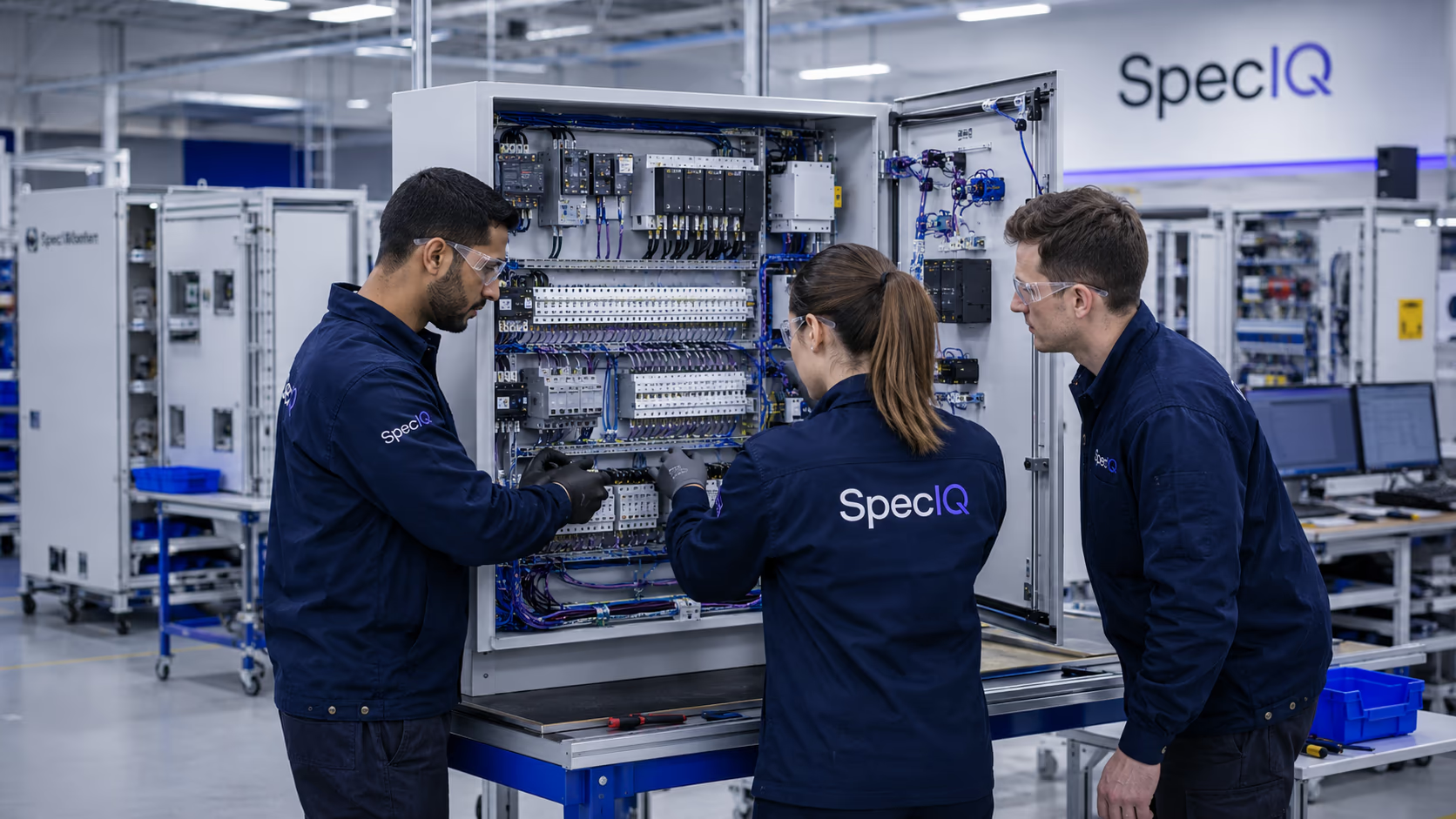
On paper, a field-built panel and a factory-built panel cost the same. The components are the same. The disconnect, the contactors, the I/O modules, the wireway — all of it comes from the same distributors at the same price. If you stop reading the project budget at the bill of materials, the two options look interchangeable.
The bill of materials is not where the cost lives.
Where the money actually goes
We’ve built panels in a controlled factory environment, side by side, with panels that the same crews built on the job site that week. The component costs were identical to the dollar. The total cost to the project — measured all the way through commissioning and the first year of operation — diverged by a multiple, every time.
The difference shows up across four categories that rarely make it onto the proposal sheet:
Labor, but not the labor you’re tracking
Most contractors track labor at the build stage and assume that’s the whole picture. It isn’t. The labor that drives the spread is the labor that happens after the panel is on the wall:
- Troubleshooting nuisance trips that trace back to inconsistent wiring
- Locating the right field tech to debug a panel built by someone else
- Re-pulling conductors that didn’t get terminated to torque spec
- Re-keying enclosures because the lock pattern wasn’t standardized
A factory-built panel arrives wired identically to every other panel of the same SKU we’ve ever shipped. The field tech who installs panel #200 has already serviced panels 1 through 199 — every one of them has the same terminal block layout, the same internal wireway routing, the same labels in the same places. The mean time to repair drops dramatically once the panels stop being snowflakes.
Inspection failures and the rework loop
The second cost category is inspection. Code-compliant panel building is not optional, and the rework cost of a failed inspection is much larger than the cost of doing it right the first time.
The most expensive inspection failures we’ve seen on jobs that ended up calling us in:
- A 6-panel BAS deployment in a Class B office tower that needed a full re-wire because the field crew used 14 AWG on a 30A circuit.
- A retrofit in a hospital wing where the inspector found that none of the panels carried a UL 508A label — the building owner had to absorb the cost of pulling and replacing every panel.
- A school district roll-out where 11 of 14 panels failed on the second inspection visit because the lock-out tag-out provisions hadn’t been built into the enclosures.
Every one of those is rework that wouldn’t have happened with a factory-certified panel — and every one of them was billed back to the contractor, not to the building owner.
The DOA tax
The third category is DOA — dead on arrival. Components that test fine individually can still fail under load when they’re wired together for the first time. A panel that goes through 48 hours of burn-in testing in a controlled lab environment catches the infant-mortality failures before the panel ships. A panel that gets energized for the first time in a mechanical room finds those failures the hard way — usually at 4pm on a Friday with the GC standing over it.
We see typical field-built DOA rates between 8% and 15% on first energization. Our DOA rate after 48-hour burn-in sits below 1%.
The service-call multiplier
The fourth category compounds over time. A field-built panel is, by definition, a one-of-one. The field tech who installs it leaves with the only copy of the wiring documentation in their head. Two years later, when the panel needs service, the original tech is on another project — or has left the company — and the service team starts from scratch.
Factory-built panels are documented at the SKU level. The same SKU lives in our system forever, with the bill of materials, the as-built diagrams, and the burn-in test results all tagged to it. Service calls against that SKU benefit from every prior service call. The institutional knowledge accumulates instead of evaporating.
What the five-year math looks like
We ran the comparison for a hypothetical 25-panel BAS deployment across three buildings in the same campus. Mid-range component cost, standard union labor rates, a typical urban inspection regime. Five-year window.
The bill-of-materials cost was identical between the two options. Every other line item diverged:
- Build labor: field-build came in 18% lower (no factory overhead to amortize)
- Inspection passes: factory-build cleared on the first pass; field- build averaged 1.4 passes per panel
- Year-one DOA: 3 field-built panels DOA’d at first commissioning; 0 factory-built panels DOA’d
- Service calls: field-built averaged 2.1 service calls per panel over five years; factory-built averaged 0.4
- Re-engineering cost when the second building came online: $0 for the factory-built (just reorder the SKU); $14,400 for the field-built (re-spec, re-source, re-document)
Five-year total: factory-build came out 31% lower despite the higher build-stage invoice. The component bill-of-materials, where the field- build had its only structural advantage, accounted for 22% of the total cost. The other 78% was where the math actually got decided.
What we’d ask you to compare
If you’re evaluating two panel proposals — one factory-built, one field-built — and the field-built quote is significantly cheaper at the top line, ask the questions that surface where the cost actually lives:
- Does the panel ship UL 508A certified, with the label on it, before it leaves the shop?
- Has the panel design been wired and tested at full load, or is the first power-up going to happen at your job site?
- Is the bill of materials documented at a SKU level that can be reordered in five years, or is each panel a one-off?
- How long are the wiring diagrams and test results retained?
A “no” to any of those means the proposal is pricing the bill of materials, not the panel. The rest of the cost is going to show up — it just won’t be on the proposal sheet.
When you’re ready to run the numbers on your specific project, the panel cost calculator does this comparison for any panel count and panel type. The ballpark estimator is the quicker version if you just want a 30-second range. Or request a quote and we’ll work through your actual spec.